

Ahmed Awad, Claudio Bernuzzi, Marco Simoncelli
Politecnico di Milano – Department of Architecture, Built environment and Construction engineering, Milano, Italy
Come noto, mantenere l’integrità operativa e la sicurezza delle infrastrutture chiave durante gli eventi sismici è di vitale importanza. Tra la questioni principali c’è sicuramente la protezione sismica delle componenti non strutturali e degli impianti, come apparecchiature HVAC (riscaldamento, ventilazione e condizionamento dell’aria), generatori e sistemi UPS (gruppi di continuità). L’articolo riguarda l’analisi delle metodologie di qualificazione sismica, delle norme pertinenti e della normativa vigente per la progettazione sismica di elementi e apparecchiature non strutturali. Vengono inoltre presentate le indagini sperimentali condotte con l’ausilio di una tavola vibrante triassiale su un refrigeratore industriale (chiller). Infine, sono discussi i risultati dei modelli teorici semplificati sviluppati per predire il fattore amplificativo delle apparecchiature isolate con supporti antivibranti.
 1. INTRODUCTION
When seismic events occurs, ensuring the continued functionality and safety of vital infrastructure stands as a critical imperative. Among the various measures required for safeguarding infrastructure, the seismic protection of non-structural components and machinery appears of paramount importance because these components, ranging from HVAC equipment to Generators and UPS systems, play key rolesin maintaining operational integrity during seismic disturbances.
It is worth noting that the damage of the nonstructural components gives the largest contribution to the economic loss due to an earthquake, representing structural cost a small portion of the total one [1] for offices (18%), hotels (13%) and hospitals (8%) [1]. During a seismic event, for these reasons, the prediction of the seismic performance of nonstructural elements is very important.
The paper delves into a meticulous examination of seismic qualification methodologies, pertinent standards, and the prevailing norms governing the seismic design of non-structural elements and equipment.
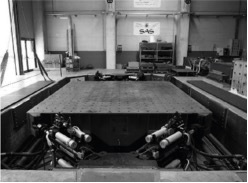
Through experimental investigations and refined analyticalapproaches, the efficacy of existing practices is hereby considered in fortifying infrastructure against seismic hazards. Experimental studies conducted utilizing a triaxial seismic table are central to the discussion, focusing particularly on an industrial chiller isolate with sprig anti-vibration mounts. Similar studies on non-structural elements were conducted on plasterboard continuous suspended ceilings using shaking table tests. Two ceiling types were tested [2] and 5 accelerograms have been used to match a required response spectrum (RRS) based on the design spectral response acceleration (SDS). These were scaled for SDS values from 0,30g to 1,50g. Another study on non-structural elements [3] explored the seismic performance of UPS units using shaking table tests based on the requirements of ICCES-AC156[4]. It compared UPS units supported by conventional pins with those using new isolator systems of high hysteresis-laminated rubber and stainless steel wire rope. The results show that the isolator systems significantly improve seismic performance, reducing fundamental frequency, peak acceleration, and amplification factors while increasing damping ratio and displacement. […]
Leggi l’articolo completo su Costruzioni Metalliche n. 5/2025.